Recognised booking service provider · registered with the FPS Economy
The EU rewards your investment in charging infrastructure. We convert that reward to cash in your account.
Every kWh you supply to an electric vehicle — public, semi-public or private — helps decarbonise the European transport system. For this, the EU grants you, as the owner of charging infrastructure, renewable energy certificates: so-called e-credits. Fossil fuel suppliers purchase these e-credits to prove their greening. We handle the data collection, registration, quarterly reporting, and sales. You will see the reward in € per quarter appear in your account.
No upfront investment. No cure, no pay.
10 days after the end of the quarter, our doors close for new agreements
50+
charging hubs in Belgium are already redeeming their e-credits through us
registrations for Q3 end in 28 Days 11 Hours 13 Minutes 18 Seconds
€ 3,240
net to the account at 100 MWh/y with a three-year agreement 3Y
Why we exist
Our work is only done when every investor in charging infrastructure in the EU has gained access to that reward, and that reward is maximally utilised by directly linking renewable electricity generation to the EV chargers.
Today, only a fraction of the charging stations that qualify effectively use the system. Not because it is not worthwhile, but because no one inside the company picks it up. Every quarter that passes without a declaration is definitively lost income.
What's in it for your charging hub?
Fill in below what you know: the number of charging points, your annual consumption in kWh, or the number of kilometres your fleet drives electrically. You will immediately see what you net after a contract of one, three, or five years.
You can also simulate what 100% renewable electricity generated on your site does with your yield in 2027.
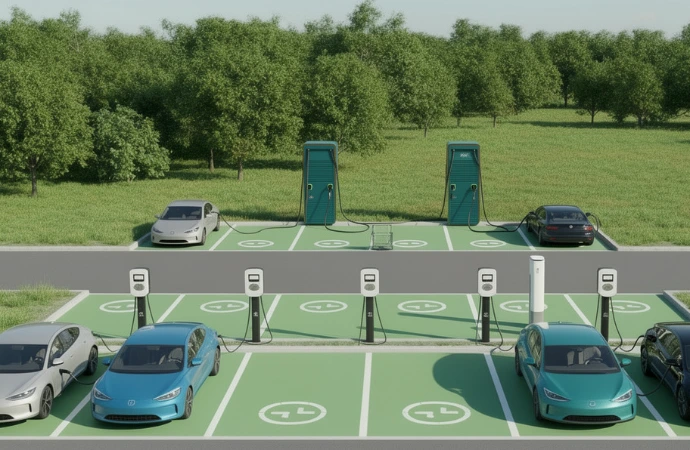
Do you drive electrically? Then every kilometre earns money back.
If your fleet charges on your own charging infrastructure, every kilowatt-hour charged generates e-credits. For a passenger car, this amounts to about € 8 per 1,000 driven kilometres. For heavy transport, it is much higher: an electric tractor that consumes 130 kWh per 100 km generates over € 5 per 100 km.
- One electric truck, 80,000 km per year: over € 3,350 net per year
- Fifty vans, each 30,000 km per year: over € 15,700 net per year
- One hundred company cars, each 25,000 km per year: over € 17,700 net per year
The larger your fleet, the smaller our share: our handling fee is capped at € 2,499 per year for a three-year agreement 3Y and € 1,999 for five years, only for our first 100 charging stations. With a million charged kWh, this means an effective handling fee of 5.9% instead of 20%.
Our process in four simple steps
1
Onboarding and registration
We assess your charging infrastructure against the legal requirements and register your charging points with the FPS Economy via an authorisation form. You give us access to your CPO or manufacturer platform.
2
Quarterly data extraction
We read your charging sessions directly from your CPO platform or manufacturer's management system. At the source, audit-proof. You don't need to send us anything.
3
Compliance and reporting
We check the data of the charging sessions for consistency and submit each quarterly declaration to the FOD Economy, within the legal deadline, and assist with government audits.
4
Trading and payment
We pool your e-credits with those from dozens of other charging stations and sell them as a single block to fossil fuel suppliers. Greater volume, stronger negotiating position, better price. The deal sheet is shared at the time of payment, with complete transparency.
Your effort: one signature and one read-only access.
That's it. You sign the authorisation form for the FOD Economy and give us read access to your CPO platform. After that, you will hear from us every quarter, and via our platform you can continuously track your e-credits online.
- No new hardware, if your charging points are already MID metered.
- No new platform and no new software.
- No invoice from us, just a self-bill. We deduct our fee from the revenue.
Carrier-grade, no administration for you.
E-credits are essentially a measurement and settlement issue: retrieving session records from various systems, valuing them correctly, and settling on time against a deadline that allows no extensions. At the same time, we ensure that our approach for your charging infrastructure has carrier-grade availability: better than 99.999% of the time available for your customers (the proverbial "five nines"). That is precisely the expertise we bring from the telecom world.
We read your data at the source from the CPO platform, not from a spreadsheet that you send us. Each kWh is traceable to a MID-certified measurement and holds up in an audit. The legal reporting deadline is fourteen days after the end of the quarter. We close our doors on day ten, as we still need to process the data and check for consistency. What comes in after the 14 days is no longer legally valid — so we never rely on the last day.
We bundle volumes and sell as one block instead of as separate files.
And from 2027, we will help you connect renewable generation to your chargers, making the same MWh worth more than three times as much (see our FAQ for more info).
Our deadline discipline
We submit your quarterly declaration within the legal timeframe. We schedule each declaration ten days after the end of the quarter, four days before the legal deadline. Since our start, we have not missed a single declaration.
Is your charging hub eligible?
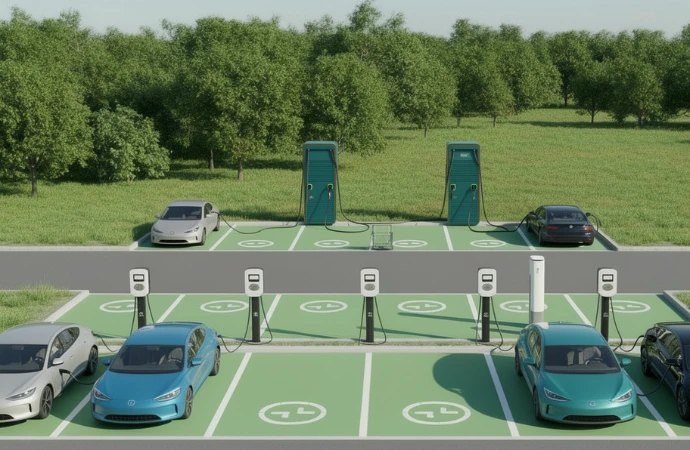
Public
Charging points that are accessible to all EV users. No minimum power required.
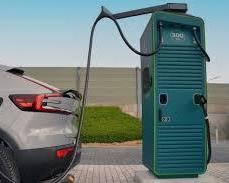
Semipublic
Charging points on private property that are accessible to third parties: business parks, retail, hospitality, hotels, etc. No minimum power required.
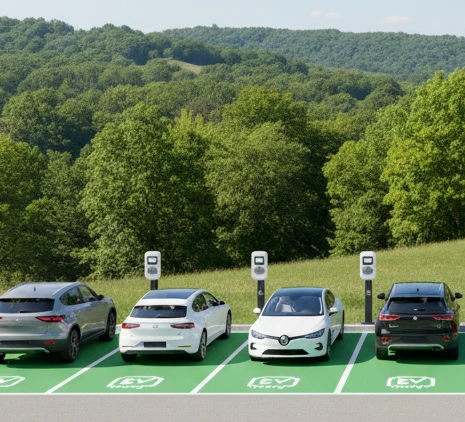
Private
Charging points on a secured business site, from 50 kW cumulative installed power at one address. (Three AC charging points of 22 kW are sufficient, for example.)
Your charging points must be able to deliver at least 3.7 kW per plug, be metered with a MID-certified meter, and automatically log their sessions via a CPO platform or the management platform of the charging point manufacturer. Charging points at a private residence are currently excluded, even when that residence is owned by a company.